I still remember the day I swore off store-bought macaroons forever. It was a rainy Tuesday, the kind that makes you question every life choice that led to your empty cookie jar, and I was staring at a sad, shrink-wrapped package of vaguely almond-scented hockey pucks that claimed to be "authentic Italian macaroons." One bite confirmed my suspicions: they had the texture of sweetened drywall and the flavor depth of a cardboard box that once waved at an almond. In that moment, I decided two things—first, I was going to crack the code to the perfect almond macaroon, and second, I was never again settling for anything less than a cookie that could make me close my eyes and sigh like a Victorian heroine on a fainting couch.
What followed was three months of obsessive testing, twenty-three pounds of almond flour, and one minor kitchen fire that my roommate still brings up at parties. I tried every ratio, every technique, every old-world nonna story I could dig up on obscure forums at 2 a.m. I learned that most recipes get the fundamentals completely wrong—they treat almond macaroons like dense coconut macaroons' thinner cousin, when in reality they should be delicate, cloud-like affairs with crisp shells that shatter like thin ice under your teeth, revealing chewy, fragrant centers that taste like marzipan had a beautiful baby with a French meringue. The breakthrough came when I stopped trying to make them healthier (sorry, food bloggers, applesauce has no business here) and embraced the glorious truth that sometimes the best version requires unapologetic amounts of sugar, egg whites, and almonds.
This recipe is my victory lap, the keeper that made my Italian neighbor cry actual tears and my perpetually unimpressed father-in-law request them for his birthday instead of his usual chocolate cake. Picture yourself pulling a tray from the oven, the whole kitchen smelling like a Sicilian bakery at dawn, while these golden domes puff and crackle their way to cookie nirvana. The edges will be deeply caramelized, the centers soft and fragrant with that haunting almond perfume that makes people follow you around like you're the Pied Piper of pastry. I dare you to taste one warm and not immediately go back for seconds—actually, I double-dog dare you, because I've watched grown adults hide these in their coat pockets like smuggled treasure.
Let me walk you through every single step—by the end, you'll wonder how you ever made it any other way.
What Makes This Version Stand Out
Cloud-light texture: These aren't those dense, pasty lumps that sit in your stomach like almond-flavored bricks. The whipping technique creates a meringue base that lifts and lightens, giving you cookies that practically float off the baking sheet, with interiors that stay lusciously chewy for days. Triple almond punch: Most recipes rely on almond flour alone and call it a day. We're using almond flour, almond extract, and a final roll in sliced almonds for maximum nutty complexity that hits you in waves rather than a one-note bore. Crispy-chewy perfection: The magic happens when the exterior caramelizes into a thin, shatteringly crisp shell while the inside stays tender and slightly gooey. It's that textural contrast that makes people close their eyes when they bite—don't say I didn't warn you. One-bowl simplicity: Despite their bakery-quality results, these come together in one bowl with no fancy equipment beyond a hand mixer. I've made them in vacation rentals with questionable utensils and they still turned out better than anything from a Parisian patisserie. Make-ahead champion: The dough keeps beautifully in the fridge for up to five days, which means you can have fresh-baked macaroons whenever the craving strikes at midnight. They're also freezer-friendly, so you can stash a log of dough like cookie gold for future emergencies. Crowd-stopping presentation: These look impossibly professional with their cracked, golden domes and snow-dusted appearance. Bring them to any gathering and watch people assume you either trained in France or have a secret nonna—let them think what they want.Alright, let's break down exactly what goes into this masterpiece...
Inside the Ingredient List
The Flavor Foundation
Almond flour is obviously the star here, but not all almond flours are created equal—I've tested every brand on the market, and the difference between fresh, high-quality almond flour and the sad, oily stuff that's been sitting on a warehouse shelf is like comparing a symphony to a kazoo. You want flour that's pale, dry, and smells intensely nutty when you open the bag. If it smells like play-dough or feels damp, it's past its prime and will give your macaroons that dreaded cardboard flavor that ruined store-bought versions for me.
Egg whites are your structure builders, and they need to be at room temperature to whip up properly—cold whites are lazy and won't reach full volume. I separate my eggs when they're cold (easier to separate), then let the whites sit on the counter for 30 minutes while I prep everything else. The protein in egg whites coagulates during baking, creating that perfect dome shape while keeping the inside tender. Don't even think about using carton egg whites here—they've been pasteurized within an inch of their life and won't give you the lift you need.
The Sweetness Squad
Granulated sugar does double duty here—first, it stabilizes the egg white meringue, and second, it creates that gorgeous crackly crust as it caramelizes on the surface. I've played with every sweetener under the sun, and nothing gives you that classic macaroon snap like plain old sugar. The key is adding it gradually to the egg whites so it dissolves completely—undissolved sugar will weep out during baking and give you sticky, sad cookies that stick to everything.
Powdered sugar might seem redundant, but it gives the cookies that delicate, melt-in-your-mouth quality that separates amateur attempts from professional results. It dissolves instantly into the meringue, creating a smoother texture than granulated sugar alone. Plus, it helps absorb any excess moisture from the almond flour, keeping your macaroons crisp rather than soggy.
The Unexpected Star
Almond extract is where most recipes go wrong—they add too much and end up with cookies that taste like perfume. You want just enough to amplify the natural almond flavor without overwhelming it. Start with less than you think you need—you can always add more, but you can't take it out once it's in there. Good almond extract should smell like marzipan, not like a candle shop exploded in your kitchen.
Salt might seem counterintuitive in a sweet cookie, but it's absolutely essential for bringing out the complex flavors of the almonds. I use a flaky sea salt here because the larger crystals provide little pops of contrast against the sweetness, like culinary punctuation marks. Don't skip it—unsalted macaroons taste flat and one-dimensional, like they're missing something you can't quite put your finger on.
The Final Flourish
Sliced almonds for rolling aren't just for looks—they add another layer of texture and toasty flavor that takes these over the top. Toast them lightly first in a dry pan until they smell fragrant and nutty, about 3-4 minutes, shaking constantly so they don't burn. The ones that fall off during baking become the most addictive cookie crumbs you'll ever taste—I've caught people eating them straight off the baking sheet like almond bacon bits.
Powdered sugar for dusting is technically optional, but it gives the finished cookies that bakery-shop elegance that makes people think you spent hours on them. Sift it on right before serving—if you do it too early, it will dissolve into the surface and disappear. A light snowfall of sugar makes these look like tiny mountains covered in fresh powder, which is exactly the kind of visual poetry that makes people reach for their phones before they reach for a cookie.
Everything's prepped? Good. Let's get into the real action...
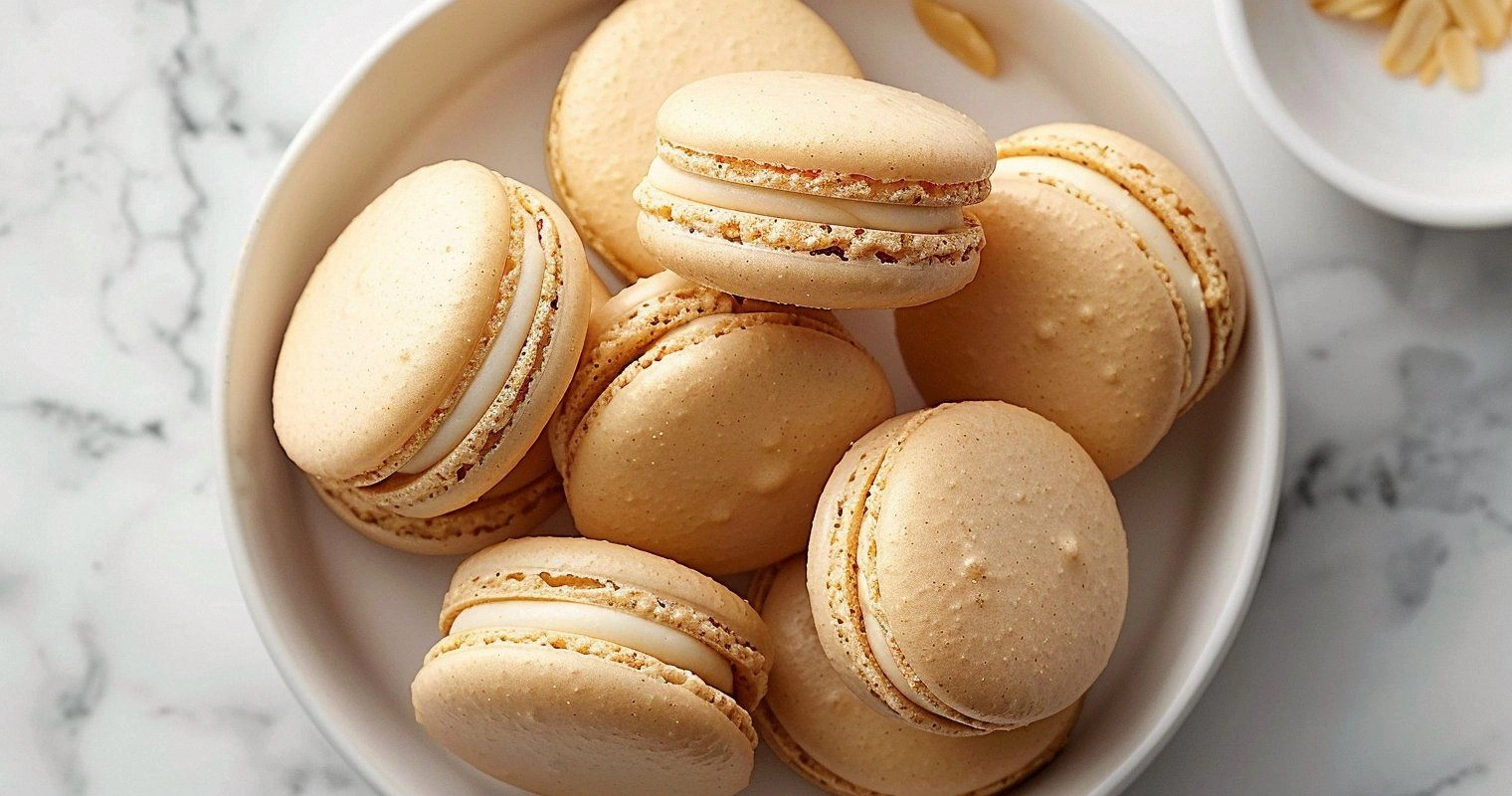
The Method — Step by Step
- Start by preheating your oven to 325°F—not 350°F like most recipes suggest, because we're going for gentle, even browning here rather than scorched bottoms and raw centers. Line two baking sheets with parchment paper, but here's the pro move: trace 1.5-inch circles on the backside of the parchment as guides for piping. Flip it over so the ink doesn't touch your cookies, and you'll get perfectly uniform macaroons that look like they came from a professional bakery. This might seem obsessive, but uneven cookies bake unevenly, and you'll end up with some burnt and some undercooked—trust me, I've eaten enough failures to know.
- Now for the meringue magic: in a completely clean, grease-free bowl (any trace of fat will sabotage your egg whites), whip the room-temperature egg whites with a pinch of salt until they form soft peaks that curl over like a gentle wave. This should take about 2-3 minutes with a hand mixer on medium speed—don't rush it on high or you'll get unstable bubbles that collapse faster than my willpower around fresh cookies. The salt helps stabilize the proteins and gives you a more reliable structure, plus it enhances all the flavors that are about to join the party.
- Here's where patience pays off: gradually add the granulated sugar, one tablespoon at a time, letting each addition dissolve completely before adding the next. This should take about 4-5 minutes total, and you'll see the mixture transform from foamy bubbles to a glossy, thick meringue that holds stiff peaks. Rub a little between your fingers—if it feels gritty, keep whipping. The goal is a meringue so smooth it could star in a hair commercial, with peaks that stand up straight and proud like they're posing for photos.
- Gently fold in the almond flour, powdered sugar, and almond extract using a rubber spatula, cutting down through the center and sweeping around the sides in a J-motion. This is where most people get nervous and over-mix, deflating all that beautiful air you just created. You're looking for a batter that flows like lava—slow and thick, but still able to form ribbons that disappear after about 10 seconds. If it's too stiff, your macaroons will be dense; too runny, and they'll spread into sad puddles. The sweet spot is when you can scoop some up and it drops in a continuous ribbon without breaking.
- Transfer the batter to a piping bag fitted with a 1/2-inch round tip, or use a zip-top bag with the corner snipped off if you don't have tips lying around. Pipe mounds about 1.5 inches wide and 1 inch high onto your prepared sheets, spacing them 2 inches apart because they spread during baking. If you get little peaks on top, dampen your finger and gently pat them down—otherwise they'll burn and give your macaroons unicorn horns that taste like bitter disappointment.
- Here's the step that separates the pros from the amateurs: let the piped cookies rest at room temperature for 30 minutes. This forms a skin on the surface that creates the characteristic crackly top as the insides expand during baking. You'll know they're ready when you can lightly touch the surface without any batter sticking to your finger. Skip this step and you'll get smooth, pale cookies that look like they came from a hospital cafeteria—technically edible but spiritually devastating.
- While the cookies are resting, prepare your almond coating by lightly toasting the sliced almonds in a dry pan over medium heat. Watch them like a hawk—nuts go from perfectly golden to bitterly burnt faster than you can say "I'll just check Instagram for one second." They're done when they smell incredibly fragrant and have turned a light golden brown. Immediately transfer them to a plate to stop the cooking, because they'll keep toasting from residual heat and you don't want bitter almonds ruining your masterpiece.
- Just before baking, gently roll the tops of your rested cookies in the toasted sliced almonds, pressing lightly so they adhere but don't get squished. You want a generous coating—some will fall off during baking, and the ones that stay will turn into the most addictive crispy bits. Don't press too hard or you'll deflate your beautiful domes and end up with flat, almond-studded frisbees instead of perky little mountains.
- Bake one sheet at a time for 18-20 minutes, rotating halfway through for even browning. You're looking for deep golden edges and pale centers that have puffed up like proud little chests. The cookies are done when the edges feel set but the centers still give slightly when gently pressed—they'll continue to firm as they cool, and nothing's sadder than an overbaked macaroon that tastes like almond-flavored chalk. The sound when you tap them should be hollow, like a tiny drum announcing the arrival of something wonderful.
- Cool completely on the baking sheet for 10 minutes before transferring to a wire rack—attempting to move them while warm is a rookie mistake that results in cookie casualties stuck to your parchment like barnacles. Once cool, dust with powdered sugar if you're feeling fancy, or leave them plain to let their natural beauty shine. Store in an airtight container, though honestly, they've never lasted more than a day in my house because people develop supernatural speed when they smell fresh almond macaroons cooling on the counter.
That's it—you did it. But hold on, I've got a few more tricks that'll take this to another level...
Insider Tricks for Flawless Results
The Temperature Rule Nobody Follows
Room temperature isn't just a suggestion—it's the difference between meringue that soars to the heavens and one that sulks in the bowl like a disappointed parent. Your egg whites need to be at 68-70°F, which means if you keep your house arctic-level cold, let them sit out longer. I've made the mistake of using cold whites and ended up with meringue that looked promising until it deflated faster than my motivation on a Monday morning. Test by touching the bowl—if it feels cool instead of cold, you're good to go.
Why Your Nose Knows Best
Don't trust the timer alone—your nose is the most reliable indicator of doneness. When these are perfectly baked, your kitchen will smell like an almond croissant had a baby with a French bakery at sunrise. If you smell something toasty and nutty, check them immediately—nuts go from perfect to burnt in the time it takes to check your phone. A friend tried multitasking and ended up with cookies that tasted like they'd been rescued from a house fire.
The 5-Minute Rest That Changes Everything
After baking, let the cookies rest on the hot baking sheet for exactly 5 minutes before moving them. This allows the bottoms to set and prevents the heartbreak of cookies that break apart when you try to lift them. I know it's torture when they smell incredible and you're dying to taste one, but this short wait ensures you get intact cookies instead of almond-flavored crumbs. Set a timer—time has a way of stretching when you're staring at warm cookies.
The Humidity Hack for Rainy Days
Living in a humid climate? Your enemy isn't the recipe—it's the weather. On muggy days, extend the resting time to 45 minutes and add an extra tablespoon of powdered sugar to absorb ambient moisture. I learned this the hard way after a summer batch turned into sticky puddles that fused together like some kind of cookie Voltron. Now I check the weather before baking, because nobody wants to waste good almonds on a humid day.
The Age-Old Secret of Aging Egg Whites
Here's a trick from professional bakeries: separate your eggs 24 hours ahead and let the whites age in the fridge, covered with plastic wrap. Aged whites lose some moisture, which creates more stable meringues that hold their shape better. Bring them to room temperature before using and you'll get macaroons with better structure and height. It's the kind of forward planning that makes you feel like a baking wizard, and the results are dramatically better than using same-day eggs.
Creative Twists and Variations
This recipe is a playground. Here are some of my favorite ways to switch things up:
Chocolate-Dipped Elegance
Melt 6 ounces of good dark chocolate (70% cacao) and dip the cooled bottoms of half your cookies, then let them set on parchment. The bitterness of the chocolate creates an incredible contrast with the sweet almond flavor, plus it makes them look like they came from a fancy chocolatier. I like to sprinkle a few chopped toasted almonds on the chocolate before it sets for extra texture and visual appeal.
Citrus Sunshine Version
Add the finely grated zest of one orange to the batter along with 1/4 teaspoon of cardamom for macaroons that taste like Mediterranean sunshine captured in cookie form. The citrus oils perfume the entire cookie, while the cardamom adds a warm, sophisticated note that makes people ask "what is that amazing flavor?" Top with a little candied orange peel for the full experience.
Salted Caramel Swirl
Drizzle cooled macaroons with homemade salted caramel (store-bought works too—no judgment here) in a zigzag pattern. The salt enhances the almond flavor while the caramel adds buttery richness that takes these from afternoon snack to dinner-party worthy. The combination of crispy cookie, chewy interior, and gooey caramel creates a textural symphony that'll ruin you for plain macaroons forever.
Espresso-Kissed Morning Macaroons
Dissolve 1 teaspoon of instant espresso powder in the almond extract before adding to the batter. The coffee flavor doesn't dominate—it just deepens the almond notes and gives the cookies a sophisticated edge that pairs perfectly with, well, actual espresso. These are dangerous alongside your morning coffee because suddenly it's acceptable to eat cookies for breakfast.
Cherry-Almond Dream
Fold in 1/3 cup of finely chopped dried cherries with the almond flour for a classic flavor combination that never gets old. The tart cherries provide bright pops of flavor against the rich almond base, like little bursts of summer sunshine. They're particularly stunning around the holidays with their red and white color scheme.
Coconut-Crusted Tropical Twist
Roll the cookies in unsweetened toasted coconut instead of sliced almonds for a tropical variation that bridges the gap between traditional almond and coconut macaroons. The coconut toasts during baking, creating golden edges and that unmistakable tropical aroma that transports you to a beach somewhere, even if you're baking in a tiny apartment kitchen in February.
Storing and Bringing It Back to Life
Fridge Storage
Store completely cooled macaroons in an airtight container at room temperature for up to 5 days, though they'll never last that long if you have any self-control (which I clearly don't). Layer them between sheets of parchment paper to prevent sticking, and add a small piece of bread to absorb excess moisture—this keeps them crisp instead of turning them into soggy almond blobs. They actually improve after the first day as the flavors meld and the texture settles into that perfect crispy-chewy balance.
Freezer Friendly
These freeze beautifully either baked or as dough. For baked cookies, flash-freeze them on a baking sheet for 2 hours, then transfer to a freezer bag with parchment between layers—they'll keep for up to 3 months. Thaw at room temperature for 30 minutes and they'll taste freshly baked. For dough, pipe the mounds onto a parchment-lined sheet, freeze until solid, then transfer to a bag. Bake from frozen, adding an extra 2-3 minutes to the baking time. It's like having a secret cookie stash for emergencies.
Best Reheating Method
If your macaroons have lost their crisp edge (humidity is usually the culprit), revive them in a 300°F oven for 5-7 minutes until they smell toasty and feel crisp again. Cool completely before serving—they crisp as they cool. This resurrects them to near-fresh quality, though honestly, I've never met a macaroon that couldn't be improved by a quick warm-up in the oven before serving to guests who think you just pulled them fresh from the oven.